Showing posts with label Harvard Business Review. Show all posts

3 Leadership Nuggets for Self Aware Leaders


I’ve felt inspired by some recent thought-provoking HBR blog posts on leadership. So, I thought I would quickly share a few of the “nuggets” I’ve collected as they may be interest to other self-aware leaders who are looking to continually improve.


Net net - the older we get, the more confident we feel and the more open we are to self improvement. Women demonstrate this confidence gain more consistently over time - probably because we start out at a lower baseline (boo). The best leaders help their people move from a “proving” mindset (coming from a place of low confidence) to an “improving” mindset.

The good news - time, experience and increased self-awareness all factor into these beneficial changes in people’s mindsets and their resulting work accomplishments. I guess there is a benefit to getting older!

Fortunately, there are just 4 things:
  1. Great leaders understand how all parts and functions of the business work together to generate value. They actively work on cultivating the needed cross-functional working relationships to minimize fragmentation and poor coordination.
  2. Great leaders effectively balance instinct and analysis when making decisions. They are not prone to knee-jerk reactions because they trust the process and their teams.
  3. Great leaders have high contextual intelligence. They continuously solicit and integrate insights from all the sources and have a clear understanding of the value the business provides within the wider industry and trends.
  4. Great leaders authentically care about forming and maintaining real relationships with superiors, peers and their teams. They reach beyond the superficial, transactional level to form mutually beneficial relationships.
Great leaders know and do all 4 well while “good” leaders just 2 or 3. And lacking a strength in #4 is what trips up most executive careers because people can spot a phony a mile away. Be warm, be kind, be real.

While we know the saying that good employees leave bad bosses, being a good boss does not necessarily beget retention. In fact, team members with the good bosses received the coaching, development and support necessary to get them ready for greater responsibility and higher paying roles. These folks can be called “happy quitters” because their satisfaction with the organization remains high even when they leave for greener pastures. And with this happy quitters, good bosses create strong “alumni networks” that are beneficial to the firm long term.  

All of the “happy quitters” in my past are part of my forever team - you know who you all are!


Hope you found these nuggets as interesting and thought provoking as I did!

Empathy in the Workplace - What Does it Look Like?


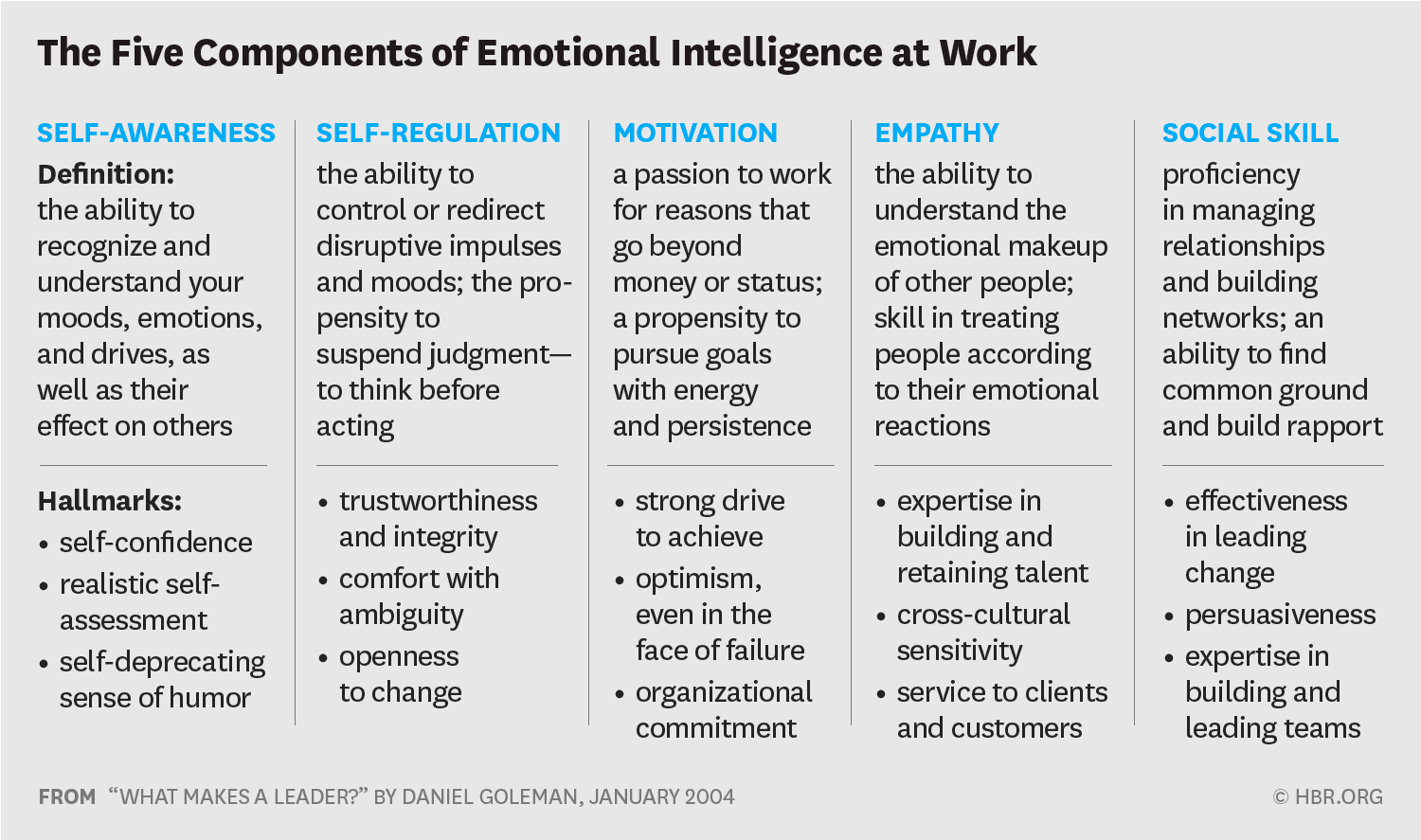
Over the years there's been a lot written about the need for leaders to have a high EQ  or emotional intelligence quotient. Harvard Business Review’s, “What Makes a Leader” outlines the 5 components of EQ at work as self-awareness, self-regulation, motivation, social skills and empathy.

EQ becomes more critical as your responsibilities expand beyond an individual contributor. Your work becomes the activities and tasks that motivate and influence the people who directly report to you and the wide map of stakeholders across and above you in the organization. Your work becomes far more about people and relationships than the black and white execution of any one work output.

In my experience, out of all of the EQ components, empathy tends to be the most misunderstood and, therefore, underutilized component. That is too bad, because empathy is the most easily coached and it’s easier to model empathetic behavior compared with developing the other components.

What does empathy look like in the workplace?
Empathy is defined as accurately perceiving and understanding another person’s emotional state and responding accordingly. Sometimes, people view empathy as primarily relating to understanding when people feel sad (closer to sympathy). When, in fact, empathy involves the whole range of emotions. And remember, people do have the whole range of feelings at work. Understanding that someone may be feeling angry, vulnerable, proud, protective, nervous, happy etc can be invaluable to you as you consider how to best communicate with them.

Just taking a moment to consider, “if I were so-and-so, how might this make me feel? Has this happened to me? How did I feel? why? Has this happened to someone I know, love or respect? how did they feel?” helps to build empathy and can create a better outcome.

In my article on demonstrating empathy when leading through an organizational change, I shared the many different feelings teams may feel when they hear the news about a change,

...people would likely feel surprised and potentially confused. They may feel nervous about being asked to transition away from the work they know into new activities with new bosses. They may feel angry about an organizational change happening “to” them outside of their control. They may feel disappointed about having to transition projects they enjoyed and pick up ones they don’t feel as enthusiastic about. They may feel all of these things at once or none of them at all…

Any reasonably self aware leader can recall being a similar situation themselves earlier in their career (maybe even that day!). By taking a quick inventory of the potential emotional states the other person/people may be in, s/he is better prepared going into the conversation and more likely to come out with a better long term result.

Taking a moment to consider how another person may be feeling - demonstrating empathy -  is beneficial even when the situation isn’t as obviously fraught like an organizational change. In status meetings where there are inter-dependent teams there will be times conflict will erupt seemingly out of nowhere. If the leader has considered how the different parties may be feeling he can actively bring that to the discussion and model what empathy looks like for group. For instance, 

Sally, you’re obviously frustrated that the commit is delayed and this is the first you’re hearing about it. Richard, would you please fill Sally in around why that was in the best interest of the project overall as she may not be aware yet of what changed in Design just yesterday.” 

A comment from the leader like this validates how Sally is feeling and reminds her to consider Richard's situation. It also coaches Richard to proactively think about how his stakeholders may react to updates and think through how to best communicate them.

Empathy is coachable
In any communication it’s not about what you want to say, it’s about what the other person needs to hear. Having empathy for the other person helps you to best communicate, motivate and influence. Empathy involves just a moment of prep actively considering the other person’s situation and how they may feel. This is a behavior that can be taught and practiced as a means to improve a promising leader’s EQ.

What are soft skills anyway?

“Soft skills get little respect, but will make or break your career.”  - Peggy Klaus, “The Hard Truth About Soft Skills

Many, if not most, professionals are smart. Countless people have the education, experience and brainpower to identify and find solutions to today’s pressing business problems. And yet, they don’t all move up the corporate ladder. We all know, at some level, that it’s not solely about being smart or performing well technically that opens up executive office doors. It is the elusive “soft skills” which play a critical part.

Soft skills are hard to name and define; and thus difficult to develop.  You need to have a clear sense of what the skills are, and then you can more easily ask for feedback and measure progress. A Harvard Business Review blog cited the Center for Talent Innovation’s study that says the most important soft skill is executive presence.

3 key elements within executive presence
Executive presence connotes that others, especially existing leaders in the organization, perceive you as “leadership material”. Some young women I have mentored have heard “you lack executive presence” as a key reason why they did not get the desired promotion or growth opportunity, but they don’t get precise feedback. Here are the top 3 elements from the study:

Gravitas
67% of the executives surveyed agreed this was a core characteristic. Gravitas comes from the Roman virtues, and connotes dignity, importance with a certain substance or depth of personality. To me, it’s about confidence and credibility; it answers the question, will people feel “safe” following you.

Communications
Your verbal communications are how you demonstrate your gravitas. It is your ability to “command a room”. It is not only in formal presentations, but even in meetings with your peers. Do you listen actively? Do you ask the right questions? Are you able to relevantly add to discussions in areas outside your sphere of responsibility?

Appearance
While not the top factor, it is clear to see how appearance could negatively impact both communications and gravitas. It’s the reason why the tried and true advice is to “dress for the job you want”. Yes, it’s true that you can’t judge a book by its cover. But it’s also true that, like it or not, your appearance will contribute to others’ perception of your gravitas and to your ability to command a room.


How to develop executive presence in your team
Personally, I never had the “executive presence” discussion with any one of my managers. It was just not talked about or named. Coming up, it seems you either had “it” or you learned “it” through osmosis. And, well, that’s just not scalable.

I’ve found that the most important thing you can do to increase your team’s executive presence is to talk about it with them. Underwhelming advice? Maybe, but truly it is that easy. Just begin talking about executive presence as a factor in how individual performance will be evaluated relative to earning promotions.

I endeavor to talk about it with every person I am fortunate to have on my team. I don’t make it a single discussion or like the awkward “talk” you have with your mom or dad at 13. I just work it into day-to-day work, 1:1’s and quarterly goal setting and performance reviews. Just talking about it increases each person’s self-awareness around how they present themselves and are perceived by others. And it provides a common vocabulary for asking for and providing feedback for improvement in this area. And it requires nothing more innovative than a conversation.


How do you think about executive presence? How are you developing your team?

Achieving "Smarketing" is challenging


Have you heard of "smarketing"?  I don’t know who is credited with coming up with the term itself, but I think it's fantastic!  

It’s a term to describe the desired alignment between an Inside Sales team and a Marketing team: Sales + Marketing = Smarketing  

I always like 'branding' complex concepts and ideas with memorable names because it provides a shared vocabulary. And, unfortunately, aligning Insides Sales and Marketing teams tends to be complex and fraught with tension. It doesn’t have to be and it absolutely shouldn’t be. If there were any two teams who need to be actively collaborating and working hand-in-hand it is inside sales and marketing. 

So why does the relationship between Inside Sales and Marketing teams get tense and complex?

This Harvard Business Review blog summarizes the key drivers of the trend of companies to move more toward inside sales.  And in includes this quote that, for me, illustrates the crux of the marketing/insides sales dynamic:

Inside Sales is a transactional engagement and the focus is on opening opportunities. Outside teams are solution and relationship based...our Inside Sales...require persistence, research and back end work

This highlights two ideas that can fuel tension between marketing and inside sales teams:

a) that inside sales is transactional and
b) the work of inside sales requires persistence and research.

Here’s the thing: if Inside Sales work is transactional, then the leads delivered by Marketing must be highly, highly qualified and just moments away from a purchase decision.  And if Inside Sales requires persistence and research, then the sales rep is accountable for actively working leads delivered by Marketing; being persistent and creative about cultivation.

So Inside Sales wants Marketing to deliver them large volumes of highly transactional leads, and Marketing expects Sales to be persistent about cultivating and closing. Tension, anyone?

I’ve found true collaboration and "smarketing" can occur if the two teams align around the business metrics that need to be optimized. And by opening the kimono around the processes of each of the teams. Active dialog on both fronts helps smooth out rough edges and keeps the expectations of each team well managed.  

In an earlier post I wrote about the many benefits of getting everyone to sing off the same metrics song sheet, and a significantly more collaborative inside sales and marketing team relationship is a key benefit.

Inside Sales is a growing trend, and Marketing leaders must embrace it. Kick it off on the right foot and actively collaborate with your sales lead. Own the process to ensure both teams are aligned on priorities and have a common view of the metrics for business success.  This will help smooth out the rough patches on your way toward true “smarketing”.

I'd love to hear from you. What are you doing to achieve “smarketing” in your organization? Any tips to share?

Good Leaders Get Out of Their Own Heads


A recent Harvard Business Review blog about team members who derail meetings, reminded me of Whitman's famous quote, "Be curious, not judgmental." Over the past few months I have shared this quote quite a bit. 

My current role has me working closely with a team in Copenhagen. Since I live near San Francisco, that's not very "close". In fact, it's over 5,000 miles, an 11 hour plane ride and a nine hour time difference. So in a typical workweek there are only about 10 hours of overlap "working" time - and that's only because I start my days with meetings at 6:30 or 7 am.

Yes, we use video conferencing and of course we use social business collaboration tools for managing team workflows and communications. Technology is how we can make it work. But it's absolutely not easy.

This experience has brought home for me just how easy it is for people to be influenced by 'group think' and subtle biases. In psychology it's called ultimate attribution error and it can be summed up as "when members of our group make a mistake, its an accident or an anomaly, but when members of another group do so, it's typical of them." 

Ultimate attribution error is apparent among people who interact every day, and it gets exponentially amplified when distance limits personal interactions and communications are primarily written and asynchronous.

In my situation, the two groups in question could not be more different. One group is the acquired start-up: a less than 20-person team, mostly co-located in one office in Copenhagen. And the other group is the acquiring multi-billion dollar company with thousands of team members in a division spanning multiple locations in California and around the world.

Even for seasoned leaders like myself who have gone through required hours of "diversity training" and have earned some self-awareness through the school-of-hard-knocks -- in the moment, I can and do get frustrated. It is difficult to always assume positive intent and to be authentically curious about the other team member's actions and point of view all day long, every day.

So multiple times each week I remind myself - and my team members in both locations - to stay mindful of this reality. I find it is especially important to take a moment in those emotionally charged times when you perceive the other person as "derailing a meeting” or “going too slow” or “doing something stupid”.   The HBR blog post says it best: you must “suspend your assumption that you understand the situation and others don’t.”

It takes strong leaders in both “groups” to be mindful of the potentially dysfunctional tendencies and biases that exist between geographically dispersed teams. Leaders must actively self-regulate their own attitudes and behaviors while also proactively address developing these important ‘soft’ skills in all team members.

I think I will post that Walt Whitman quote on my monitor to help me keep out of my own head.  What will you do?

Process is Not a Dirty Word


I am unabashedly a Harvard Business Review (HBR) blog fan and a recent HBR blog post from Sarah Green called Making Process Planning Cool Again really struck a chord.

As Green mentions, just the simple utterance of the word 'process' tends to elicit shudders of horror from Millenials and paints the speaker as an out of touch, anal retentive school-marmish librarian -- ouch!

While Green's post focuses on the work of the Toyota Production System Support Center (TSSC) - a non-profit within the auto company, process isn't just beneficial for manufacturing.  It's also necessary for effective marketing.

As any marketing leader will tell you, it's the execution of that amazing, integrated marketing strategy that moves your business metrics! And that execution means keeping many different balls in the air - from brand management, to search keyword optimization, to banner and/or print creative development, to social media posts, to media planning, to event planning, to promotions, to website A/B testing, to metric dashboard development - and the list goes on and on.

Each ball with its own discipline, specializations, tools, strengths and weaknesses.  Each element needing to pull its weight driving cost effective awareness, adoption, trial, purchase and retention while also consistently reinforcing the brand and addressing customer needs and pain points. If this juggling act doesn't scream for process, I do not know what does.

Here's why I believe process is cool. It's because for my marketing teams, process doesn't constrain, it liberates.  Process allows the blocking and tackling of coordination and optimization to be part of the "routine" -- daily, weekly, monthly, quarterly -- thus allowing us the mental freedom to invest time/energy in exploring new ideas and new tests.  It is the fact that there is a process that allows us to be creative and out of the box while also not dropping any of the many balls in the air.

So, to 'borrow' a sentiment from A Few Good Men (let's say it together with your best Nicholson impression), "somewhere, deep down inside in a place you don't talk about at parties, you want a good process, you need a good process!"