Showing posts with label HBR. Show all posts

Empathy in the Workplace - What Does it Look Like?


Over the years there's been a lot written about the need for leaders to have a high EQ  or emotional intelligence quotient. Harvard Business Review’s, “What Makes a Leader” outlines the 5 components of EQ at work as self-awareness, self-regulation, motivation, social skills and empathy.
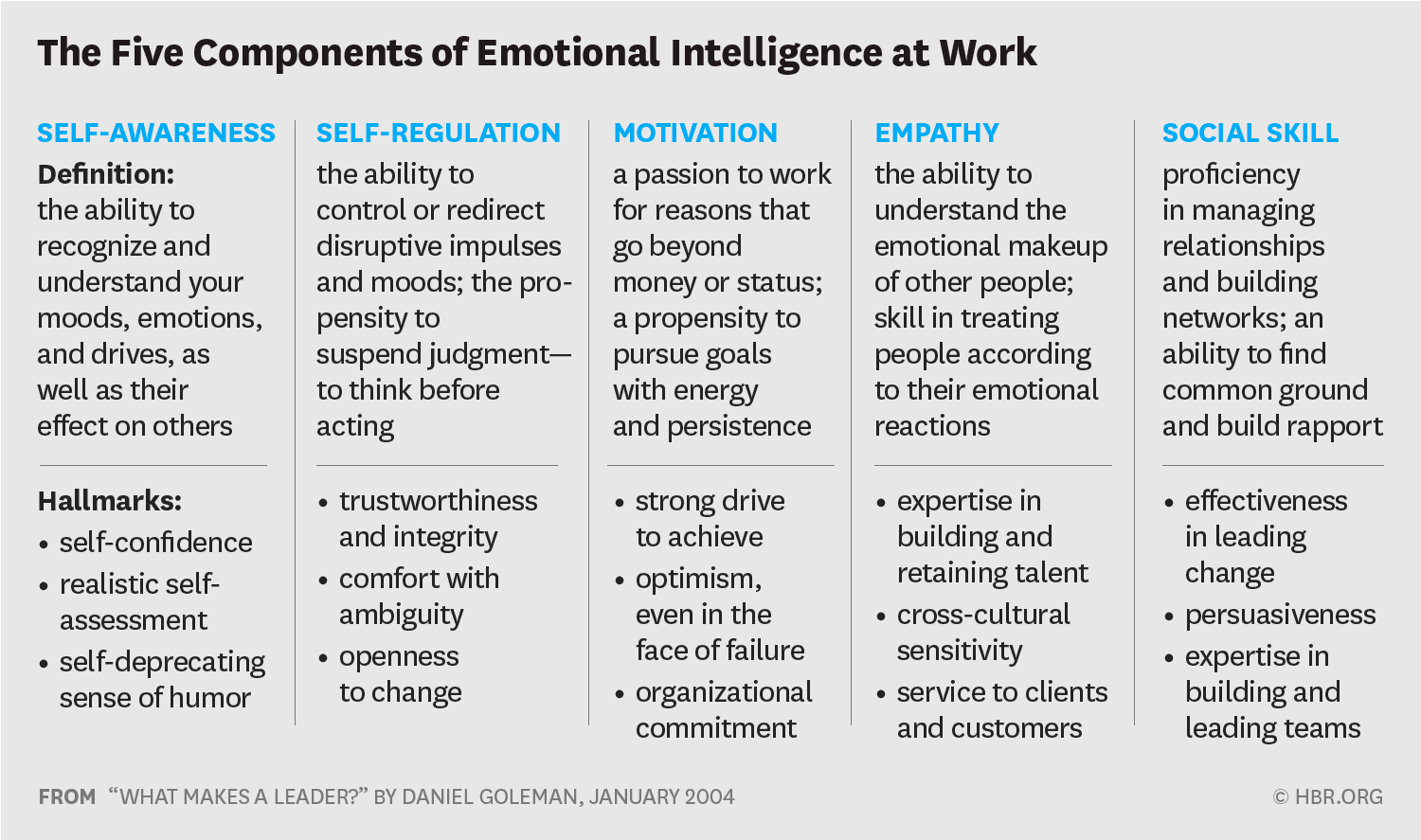
EQ becomes more critical as your responsibilities expand beyond an individual contributor. Your work becomes the activities and tasks that motivate and influence the people who directly report to you and the wide map of stakeholders across and above you in the organization. Your work becomes far more about people and relationships than the black and white execution of any one work output.

In my experience, out of all of the EQ components, empathy tends to be the most misunderstood and, therefore, underutilized component. That is too bad, because empathy is the most easily coached and it’s easier to model empathetic behavior compared with developing the other components.

What does empathy look like in the workplace?
Empathy is defined as accurately perceiving and understanding another person’s emotional state and responding accordingly. Sometimes, people view empathy as primarily relating to understanding when people feel sad (closer to sympathy). When, in fact, empathy involves the whole range of emotions. And remember, people do have the whole range of feelings at work. Understanding that someone may be feeling angry, vulnerable, proud, protective, nervous, happy etc can be invaluable to you as you consider how to best communicate with them.

Just taking a moment to consider, “if I were so-and-so, how might this make me feel? Has this happened to me? How did I feel? why? Has this happened to someone I know, love or respect? how did they feel?” helps to build empathy and can create a better outcome.

In my article on demonstrating empathy when leading through an organizational change, I shared the many different feelings teams may feel when they hear the news about a change,

...people would likely feel surprised and potentially confused. They may feel nervous about being asked to transition away from the work they know into new activities with new bosses. They may feel angry about an organizational change happening “to” them outside of their control. They may feel disappointed about having to transition projects they enjoyed and pick up ones they don’t feel as enthusiastic about. They may feel all of these things at once or none of them at all…

Any reasonably self aware leader can recall being a similar situation themselves earlier in their career (maybe even that day!). By taking a quick inventory of the potential emotional states the other person/people may be in, s/he is better prepared going into the conversation and more likely to come out with a better long term result.

Taking a moment to consider how another person may be feeling - demonstrating empathy -  is beneficial even when the situation isn’t as obviously fraught like an organizational change. In status meetings where there are inter-dependent teams there will be times conflict will erupt seemingly out of nowhere. If the leader has considered how the different parties may be feeling he can actively bring that to the discussion and model what empathy looks like for group. For instance, 

Sally, you’re obviously frustrated that the commit is delayed and this is the first you’re hearing about it. Richard, would you please fill Sally in around why that was in the best interest of the project overall as she may not be aware yet of what changed in Design just yesterday.” 

A comment from the leader like this validates how Sally is feeling and reminds her to consider Richard's situation. It also coaches Richard to proactively think about how his stakeholders may react to updates and think through how to best communicate them.

Empathy is coachable
In any communication it’s not about what you want to say, it’s about what the other person needs to hear. Having empathy for the other person helps you to best communicate, motivate and influence. Empathy involves just a moment of prep actively considering the other person’s situation and how they may feel. This is a behavior that can be taught and practiced as a means to improve a promising leader’s EQ.

Becoming strategic

When I talk with young professionals early in their careers, I regularly hear a frustration along the lines of “I don’t want to just execute anymore, I want to be strategic”. 
When I mentor, I meet more than a few talented, intelligent people who are passed over for promotion because they aren’t (yet) perceived as “being strategic”.
We all want a seat at the table. It feels good to be asked to help set the course for our teams and companies to be successful. To get there, it’s necessary to build your strategy setting and communication skills in order to earn that seat. Here are a few things to think about if you want to become or be perceived as strategic:
Banish the idea that any role is “just” execution or “just” strategy
Rarely does a strategy come down from “on high” like Moses with the Ten Commandments (or McKinsey consultants with binders) to be summarily handed off for execution.  The best ideas without execution are worthless, and a strategy’s success lies in the quality of every person's day-to-day execution and decision making over a long period of time.
This quality requires a level of understanding and buy-in that doesn’t come from a one-time presentation or strategy document hand off. The best leaders know this and is why they work continuously to ensure that everyone understands how their efforts and insights supports the organization's larger strategic goals. It is infused into every one of their 1:1's, every performance review with a team member, every new idea brainstorm with a cross-functional team and likely, even worked into every casual hallway conversation.
Today, you can “be strategic” in the role you have
A key way you can be strategic in the role you have is to actively help to translate your organization's “big” strategic ideas into the day to day activities of you and your colleagues. Even when you are not the team lead, your interactions and conversations can authentically reflect this understanding and it will help keep people appropriately aligned -- and your boss will definitely appreciate that.
As HBR suggests in “Strengthen Your Strategic Thinking Muscles”, thinking strategically is about creating connections between ideas, plans and people that others fail to see. This points to you beginning today to proactively build relationships with all of your different stakeholders - both internally among the different departments you work with and externally among customers and vendors. 

If you learn what is important to your stakeholders and you understand what is important to your team and organization, you are setting yourself up to be in the right place to identify and create those important connections and deliver valuable strategic insights.


Have (and share) a point of view beyond your span of control
Being viewed as strategic means you will need to demonstrate a broader understanding of the organization beyond “just” your role. It's not enough to know your own job backwards and forwards, you need a mindset that is both long term and systematic. Long term meaning you think about the implications of decisions beyond the current quarter or fiscal year, and systematic meaning you think about the implications of decisions on your extended stakeholder network.

Thinking strategically isn't enough. You need to have the confidence to find and take advantage of appropriate opportunities to demonstrate your understanding and insights. It can be as simple as speaking up in a staff meeting to build on a colleague’s point or making an important introduction to help a colleague’s project.


Don’t forget your soft skills
Soft skills like executive presence can make or break a career. Learning to effectively manage stress is important for the rising executive because it demonstrates your ability to deal with change and your calm demeanor instills confidence in those around you. 
Mindfulness is also a necessary skill for today's strategic thinker because learning to be fully present helps improve your cognitive and communication skills. Whether you exercise, do yoga, cook or meditate -- prioritize the time for these activities so you are strong and resilient and fully able to handle the inevitable stress that comes your way.

Why I Choose to Coach and Mentor

For longer than I care to admit sometimes (20+ years), I have been working full time. I was lucky and I was given the opportunity to manage teams early on in my career. And this early start to management allowed me to gain needed experience and build a proficiency that comes from 10,000 hours of practice.

And, for me, one of the most rewarding parts of management is mentoring and coaching. I enjoy the process of helping people to clarify their goals, understand their strengths, take on new challenges and successfully build needed skills and capabilities. It is really gratifying to help someone grow and see them meet (and crush!) their career goals.

Harvard Business Review recently that Millennials value mentoring highly. These young professionals are ambitious and crave the feedback that will help them succeed. Especially useful and valuable is “micro feedback” - where a mentor’s input and feedback is provided regularly and not just at official performance review times. This kind of real-time input can be the most effective because of increased relevancy and specificity of the feedback.

HBR also suggests Millennials value micro-mentoring versus a broader, more encompassing 1:1 mentoring engagement. Much like micro and real-time feedback, micro-mentoring provides the protege needed help around a particular challenge over a given timeframe with the best mentor for that situation. This approach also allows young professionals to craft a kind-of career ‘board of directors’ with different skills, expertise and networks which are open to helping them at different times across a long career.

In addition to mentoring the people I am fortunate to work closely with, I also choose to mentor with Everwise. Everwise engages with companies with rising leaders (proteges) and connects them with mentors who work outside the protege’s company.

And while I’m not knocking internal mentorship programs, it’s been my experience that there is something special that can happen when a protege feels she can talk freely and openly about her professional goals and struggles with a mentor who has no ties with her organization. She knows I am 100% in her corner and that my advice and feedback is not at all biased by any internal politics or other agendas.

It is also helpful for them to see that the challenges they are personally facing are, in fact, very common ones faced by many women in most organizations, and that it’s not something unique to them. This insight and understanding can open them up to finding new ways to break out of old patterns and to trying new approaches that can be more successful.

As a protege, if you need another reason to look outside your own organization for a mentor, Gallup research shows us that just 1 in 10 people have the innate talent to be a “good” manager where a good one takes the time to get to know their team’s strengths and actively works on their development. This situation puts too many up and coming “good ones” at risk of being neglected, under-developed or even burnt out by “limited” managers.

Finally, if you’re one of the “good” ones, or just think you have some key experience and may have something to offer, you should consider seeking out mentoring opportunities beyond just your immediate team. Be open to it and connect with someone and work together to help them succeed. I expect it will be a positive experience for both of you.

3 ways startups hurt professional development

I’ve seen this story unfold more than a few times. Young people, straight out of college (or not), join a tech startup. They start as interns and with their high energy, can-do attitudes and simple presence in the room they become a part of one startup’s history and culture.
Cultural bonds tighten as they also find their friends (and dates) within the confines of the startup team and they learn a way of working specific to that one startup, with that team of people. And sometimes, without the context of having experienced anything or anyone else, they develop a kind of ultimate attribution error and believe this one way is “the best” way.
The people managing teams at startups may not have had any previous experience coaching people, and may not have benefited from development coaching themselves. Worse, they may have picked up some bad habits or simply don’t value it. Professional development could even be actively denigrated as a “big company” or “bureaucratic” concept.
We know the majority of tech startups end in failure or acquisition and not in highly publicized multi-billion dollar IPOs. And the reality is that these young people will likely need to work somewhere else over the course of their career. By ignoring professional development, leaders at startups are doing these young team members a critical disservice.
Things move quickly and it’s easy to see how investing time on efforts which derive long term benefit for the business and, personally, for any one team member could fall below the line. In my experience, it’s not done intentionally, but through benign neglect. And that’s a shame.
There are 3 areas of professional development that suffer the most:
Valuing diversity
Many startup teams are not at all diverse. It makes sense because it’s easiest to work closely and well with people who are most “like” yourself - gender, ethnicity, education etc. As a business grows, integrating new people into the team becomes necessary and if those tasked with recruiting lack the needed professional development around building a strong team, bias is that much more likely to creep into the hiring.
Of course, valuing diversity goes beyond hiring practices. It means seeking input and feedback from people who think, communicate and approach solving the toughest business problems differently from you. This appreciation of diversity, of difference, comes with experience and self awareness, and is generally learned from seeing it modeled and through day to day situational coaching.
Young professionals who do not have the opportunity receive this kind of coaching/development early in their career may tend to chalk up style differences to “not a good culture fit” versus recognizing the need to adapt their own style in order to get the best from different kinds of people. This lack of adaptability and understanding of situational leadership may make it harder for them to ascend to and succeed in leadership roles.
Collaboration
Many startups, in the early days, are appropriately run as “command and control”. Team size is small, communication is simple (all in one room) and there is a single priority -- build an awesome product.  Founders assign a team member to execute a desired tactic soup to nuts and this is possible because its execution doesn’t create dependencies on other departments because there are no “other” departments.  Nor are there competing priorities across functions because there are no functional teams.
As a business grows and the team grows, actual collaboration becomes necessary. One needs experience navigating and negotiating across competing needs and priorities in order to build empathy and understanding for different points of view, even when (or especially when) you disagree. True collaboration requires investing the time to understand how best to work with others for a successful execution, and this is not generally required within a command and control startup.
Soft Skills
I’ve written about how a leader’s soft skills are perhaps the most important part of professional development and are one of the hardest to coach even under the best of circumstances.  Soft skills comprise:
Gravitas is consistently displaying confidence and credibility so people will feel “safe” giving you leadership roles and following you
Communications is the ability to “command a room” and covers actively listening and relevantly adding to discussions
Appearance contributes to how others perceive you and perceive your gravitas and ability to command a room.
When the development of soft skills are neglected, or worse maligned, in startup culture, it hurts young team members most if the startup is acquired by a larger organization. Unlike founders who are looking to ‘rest and vest’ in that situation, the young team members who may want to advance their careers there are at a disadvantage because they haven’t had the soft skills coaching that would allow them to take on roles in the new organization.
For young people starting out their professional careers at a startup, I suggest proactively asking for professional development coaching and, actively seek out mentorship from leaders outside your company who may be better able to provide it.  
And for startup founders and leaders, it’s important that you keep the professional development of your teams a top priority. It isn’t “bureaucracy” or the dreaded “overhead”, it is the right thing to do to support the young people early in their careers who are helping make your vision a reality.
Related Links

What are soft skills anyway?

“Soft skills get little respect, but will make or break your career.”  - Peggy Klaus, “The Hard Truth About Soft Skills

Many, if not most, professionals are smart. Countless people have the education, experience and brainpower to identify and find solutions to today’s pressing business problems. And yet, they don’t all move up the corporate ladder. We all know, at some level, that it’s not solely about being smart or performing well technically that opens up executive office doors. It is the elusive “soft skills” which play a critical part.

Soft skills are hard to name and define; and thus difficult to develop.  You need to have a clear sense of what the skills are, and then you can more easily ask for feedback and measure progress. A Harvard Business Review blog cited the Center for Talent Innovation’s study that says the most important soft skill is executive presence.

3 key elements within executive presence
Executive presence connotes that others, especially existing leaders in the organization, perceive you as “leadership material”. Some young women I have mentored have heard “you lack executive presence” as a key reason why they did not get the desired promotion or growth opportunity, but they don’t get precise feedback. Here are the top 3 elements from the study:

Gravitas
67% of the executives surveyed agreed this was a core characteristic. Gravitas comes from the Roman virtues, and connotes dignity, importance with a certain substance or depth of personality. To me, it’s about confidence and credibility; it answers the question, will people feel “safe” following you.

Communications
Your verbal communications are how you demonstrate your gravitas. It is your ability to “command a room”. It is not only in formal presentations, but even in meetings with your peers. Do you listen actively? Do you ask the right questions? Are you able to relevantly add to discussions in areas outside your sphere of responsibility?

Appearance
While not the top factor, it is clear to see how appearance could negatively impact both communications and gravitas. It’s the reason why the tried and true advice is to “dress for the job you want”. Yes, it’s true that you can’t judge a book by its cover. But it’s also true that, like it or not, your appearance will contribute to others’ perception of your gravitas and to your ability to command a room.


How to develop executive presence in your team
Personally, I never had the “executive presence” discussion with any one of my managers. It was just not talked about or named. Coming up, it seems you either had “it” or you learned “it” through osmosis. And, well, that’s just not scalable.

I’ve found that the most important thing you can do to increase your team’s executive presence is to talk about it with them. Underwhelming advice? Maybe, but truly it is that easy. Just begin talking about executive presence as a factor in how individual performance will be evaluated relative to earning promotions.

I endeavor to talk about it with every person I am fortunate to have on my team. I don’t make it a single discussion or like the awkward “talk” you have with your mom or dad at 13. I just work it into day-to-day work, 1:1’s and quarterly goal setting and performance reviews. Just talking about it increases each person’s self-awareness around how they present themselves and are perceived by others. And it provides a common vocabulary for asking for and providing feedback for improvement in this area. And it requires nothing more innovative than a conversation.


How do you think about executive presence? How are you developing your team?

Advice for change junkies like me

If you know me, you know I love a challenge.

It's not fun unless I'm in the middle of solving a hard problem. Even better, it's a hard problem with high stakes requiring organizational change. The act of jumping in, assessing a situation, defining the opportunities, putting the right team together and watching them gain momentum - it is a rush! That's definitely where I find my "state of flow". Over the years, as I've chased my flow, I've had the opportunity to learn (and re-learn) two key lessons that may be helpful for other "change junkies" out there.

The current state is always worse than you think (and you can't fix everything at once).

When walking into a new change situation, I go in believing I have a handle on the challenges I will face. But I've learned this belief is kind of like wearing rose colored glasses, because you can't really know the truth until you get in there and get your hands dirty.

Too many times I have felt blindsided by an unanticipated speed bump. One recent example was the resource I relied on to execute my paid search marketing. He sat in the Search Marketing "center of excellence" within a matrix organization and was dedicated to my business. Given other fires burning, the search program wasn't my top priority. Yet over the course of a month's worth of status meetings, it became clear he wasn't performing. I had to put aside a number of other priorities for a few weeks in order to get it resolved. In this case, it was a fundamental misunderstanding of the chain of command and unfortunately, it cost the business a few hundred-thousand dollars.

I ascribe to the same advice shared in this HBR blog about turnarounds: you must address these unexpected challenges head on and at the time you uncover them. It's important to communicate openly about these speed bumps as you hit them, because it's likely to be a common, simmering problem that the team hasn't felt equipped to handle yet. And to insure your management chain understands that a new priority has emerged. Don't continue to feed the elephants in the room.

Work on being resilient.

There are so many speed bumps one can encounter - some you may be able to anticipate because you've hit them before, and unique ones that surprise you. I've learned that no matter how objectively "good" or "right" an idea, initiative or strategy may be, the organization has to be ready for it. This is true in both small and large organizations. And ready is more than lip service, ready means a shared urgency for making the key decisions and taking needed actions now.

This shared urgency is elusive, so you need to be resilient. I used to characterize this trait as being persistent, and while there is definitely an element of persistence in resilience - it is a necessary component - but not sufficient. Persistence implies staying the course valiantly fighting all obstacles in your way. It also implies a bit of tunnel vision, so you can miss the forest for the trees. Too much persistence may also get you labeled as stubborn and one-dimensional by peers and leaders - neither of which will help move your priorities forward.

Resilience, on the other hand, is what allows you de-personalize your response to setbacks so you are better able to synthesize new information, alter your approaches and persist in trying to execute the right ideas. But let's be clear, resilience is hard and sometimes even harder for professional women in leadership roles. It's a skill like any other that takes time, patience and awareness to develop.

The good news: if you can approach leading change situations by being open to the unexpected and working on resiliency, you will be better equipped for your next change fix!


Don't be Max Headroom with your virtual team

Do you recognize this guy? It's Max Headroom, a popular TV character in the mid 80's billed as the "world's first computer generated TV host".

Years before the Internet, Skype and YouTube, here was this charismatic, virtual man on our TV screens. He was seen only from the shoulders up, cracking wise in a bombastic way, while his image froze and skipped chaotically and his voice modulated strangely out of sync with the video. Here, watch a few clips for the context. (Humor me, I do have a point...)

Every time I hold a online meeting with my virtual team - all of them sitting in one conference room, me on my webcam - I picture my face on the big screen in their conference room and think, "from their perspective, I am Max Headroom." And that's not just because today's video conferencing technology still freezes at the worst possible times and there are audio glitches in every meeting. No, it's because while video conferencing with virtual teams members is lightyears better than "just" an email or a social stream comment or a phone call, it is still "just" virtual.

And virtual is not real life. Don't get me wrong, I am a big user of and believer in any and all the technology and tools that allow people to work flexibly. Flexibility to balance personal and professional comments or to work in a location appropriate for the task at hand, allows your team to give their best and is a must for today's workforce.

But as a team leader, step one is connecting with your team. That connection needs to be a personal, human one, not a virtual one. HBR's article Connect, then Lead explains that is our human desire to affiliate and be understood that drives this. Team members need to feel connected with their leaders in order to do their best work.

A virtual team environment, especially one where you, as the leader, are virtual, makes achieving this needed connection very challenging. I have learned you need to be both patient and deliberate.

Be Patient
I am biased for action, so this one is hard for me. Having led virtual teams for many years, and most recently teams where I was a virtual leader, this is a key lesson learned.

Authentic connection takes time so you must allow the necessary time for relationship building. People are looking for areas of commonality and consistency in behavior, and that requires multiple and varied kinds of interactions, both formal and informal, over time. So in situations where there are significant time zone differences that limit the available hours for meetings, conversation and interaction, you have to go into that situation knowing you'll need to go slow initially in order to go fast later. Like nine women can't make a baby in one month, you can't always accelerate achieving needed connection.

That being said, there are actions you can take to help build connective tissue with each interaction. And if you're deliberate about applying these tools, it will help to build and sustain good, virtual teams

Be Deliberate
Leaders of virtual teams must also be deliberate within their virtual interactions. I've learned a few tricks over the years. And when I saw this HBR Management Tip on building trust in your virtual team I had to smile, because it's one I use every day -- create forums for personal interactions to take place even in formal meetings. I always kick off online meetings with a personal anecdote designed to start a short non-work conversation. This "water-cooler-talk" helps to lighten the mood and remind everyone that we're a team of people collaborating.

Another deliberate move is to schedule and keep regular 1:1 meetings with every one of your virtual team members, not just your direct reports. You will meet and interact with your direct reports more often, but you still need to build connection with the entire team.

Don't be Max Headroom
In virtual teams, personal connection is still critically important. While technology can move us closer to real life interactions, there is still the danger of being "just" Max Headroom to your virtual team: a virtual, talking head they see on the conference room screen every week, not a living, breathing leader of a team they are proud to contribute to. Think about how you are being perceived by your virtual team and be mindful of the time needed to create connections.


Process is Not a Dirty Word


I am unabashedly a Harvard Business Review (HBR) blog fan and a recent HBR blog post from Sarah Green called Making Process Planning Cool Again really struck a chord.

As Green mentions, just the simple utterance of the word 'process' tends to elicit shudders of horror from Millenials and paints the speaker as an out of touch, anal retentive school-marmish librarian -- ouch!

While Green's post focuses on the work of the Toyota Production System Support Center (TSSC) - a non-profit within the auto company, process isn't just beneficial for manufacturing.  It's also necessary for effective marketing.

As any marketing leader will tell you, it's the execution of that amazing, integrated marketing strategy that moves your business metrics! And that execution means keeping many different balls in the air - from brand management, to search keyword optimization, to banner and/or print creative development, to social media posts, to media planning, to event planning, to promotions, to website A/B testing, to metric dashboard development - and the list goes on and on.

Each ball with its own discipline, specializations, tools, strengths and weaknesses.  Each element needing to pull its weight driving cost effective awareness, adoption, trial, purchase and retention while also consistently reinforcing the brand and addressing customer needs and pain points. If this juggling act doesn't scream for process, I do not know what does.

Here's why I believe process is cool. It's because for my marketing teams, process doesn't constrain, it liberates.  Process allows the blocking and tackling of coordination and optimization to be part of the "routine" -- daily, weekly, monthly, quarterly -- thus allowing us the mental freedom to invest time/energy in exploring new ideas and new tests.  It is the fact that there is a process that allows us to be creative and out of the box while also not dropping any of the many balls in the air.

So, to 'borrow' a sentiment from A Few Good Men (let's say it together with your best Nicholson impression), "somewhere, deep down inside in a place you don't talk about at parties, you want a good process, you need a good process!"